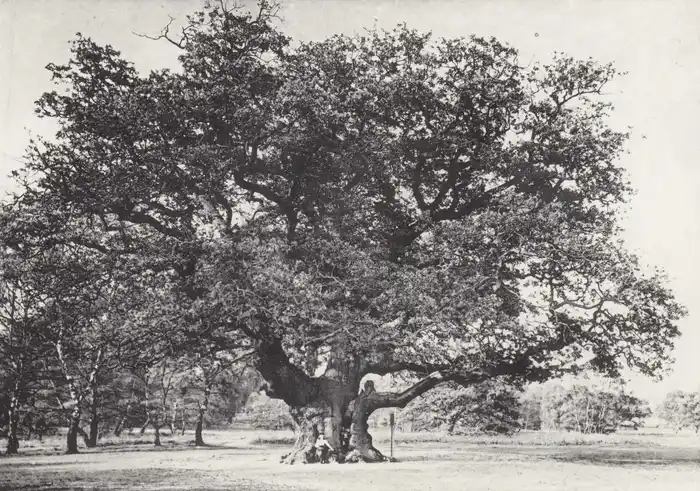
The death of the Major Oak is a sad moment (and perhaps a little on the nose as national metaphors go). It had stood for at least a thousand years, growing ring by ring and breathing England’s air. And our air today is far more CO₂-rich than the Major’s time as a sapling.
So we come not to bury the oak, but to weigh him: how much carbon is sequestered in that quercious mass?
Weighing in🔗
The boffins at Ecometrica have a good write-up explaining how one goes about measuring the carbon mass of a living tree.
The majority (roughly two-thirds) of the biomass is in the stem, with roots and branches forming a consistent proportion of that. This means that you really only need two measurements to get a rough approximation of a tree’s mass: the radius and the height of the main stem, both of which you can get without digging anything up or hacking anything down.
We’re going to start by calculating the volume of the stem as a truncated cone. The UN’s Food and Agriculture Commission has published a quick and dirty formula for this:
Volume = 0.45 x Diameter² x Height
From there, we can multiply Volume by Density to get the total Mass of the trunk.
The density of a living oak is about 1,000 kg/m³. Interestingly - and unlike us - trees tend to get little less dense with age, though for the ease of our calculations we’ll keep the standard figure.
Oaks also have a slightly lower proportion of their biomass in the stem (55%), so we shall bear that in mind when reaching our final figure.
Measuring the Major🔗
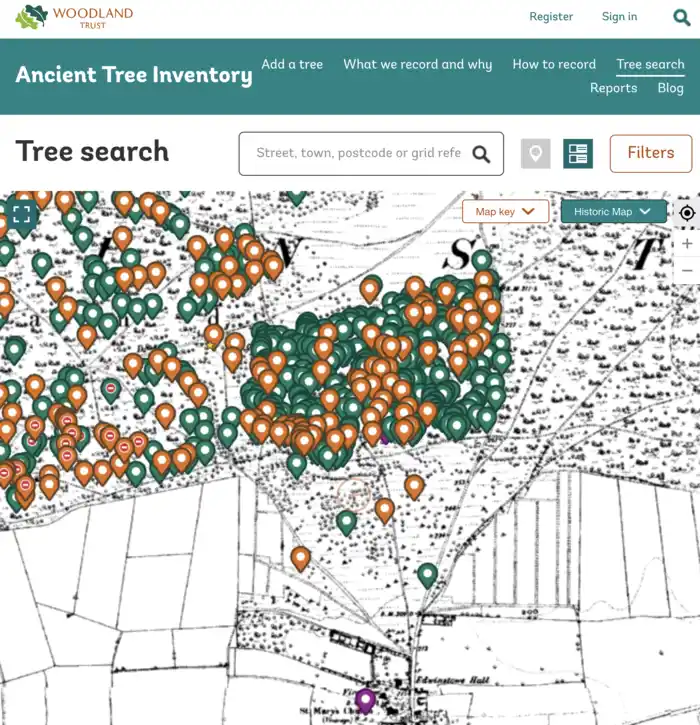 Lonely ancient oaks in your area!
To find the Major’s vitals, we can make use of the Woodland Trust’s superb Ancient Tree Inventory, an exhaustive, citizen-science catalogue of Britain’s notable trees. The Major’s entry still lists it as ‘alive’ at time of writing, but also gives us what we need: a mid-trunk girth of 10.6m. At last measure, it topped out at 24m in height.
Plugging those into our formula, we get a trunk volume of roughly 74.4m³. Assuming this is just 55% of the tree’s total mass, we multiply by 1.88 to get a total biomass - trunk, branches, roots and all - of roughly 140m³.
The density of a living oak is about 1,000kg/m³. Interestingly - unlike us - trees tend to get little less dense with age, not to mention that the Major had gaping hollows in his stem. Bearing this in mind, we’ll revise the density down by 30% to 700kg/m³.
Overall, then, we hit a total weight of 98 tonnes.
Converting to carbon🔗
Of course, that’s not all carbon.
Going back to the Ecometrica paper, they estimate about 50% of a tree’s mass is pure carbon content. The answer to our question, then:
The Major holds (roughly) 49 tonnes of carbon, equivalent to about 180 tonnes of CO₂.
What’s that in real terms?
My wheezing Jag puts out about 200g of CO₂ per mile; I’d be able to drive it sixty-five round-trips from Dubai to the old Major himself before exhausting that carbon stock.
Or instead: imagine you had been there to see the Major’s acorn sprout. Imagine you had sat beneath the boughs for every season of its millennium of life.
Infinitesimally you would watch it breathe in, drawing carbon from the air and into its mass, growing millimetre by millimetre. And you breathing out all that time: 360kg of CO₂ a year, from your lungs to the leaves above.
A thousand years; 360 tonnes out, 180 tonnes in.
Enough for every other breath.